CE / UKCA
Used for many EU and UK appliance programs. Review normally includes safety, EMC, energy labeling and documentation language. We confirm product family and destination before quoting test scope.
Global appliance programs succeed when certification is planned before the SKU enters tooling review. Our compliance team translates market requirements into a practical path for the products, packaging and documents buyers need. This page gives sourcing teams a structured view of the documents and checks normally discussed before a pilot order.
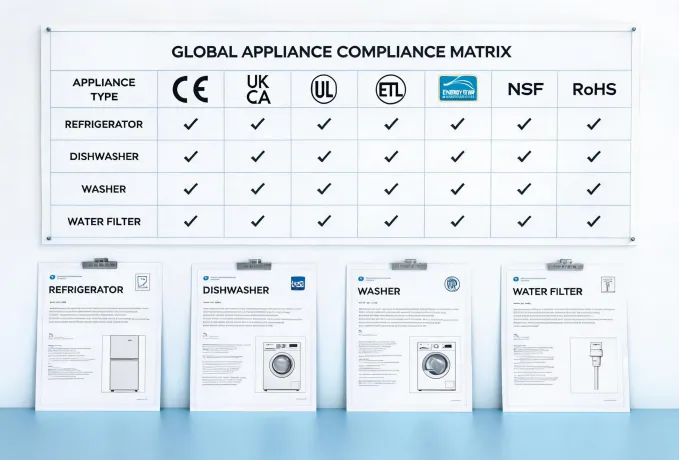
Certification work is most useful when it is connected to the exact appliance category and route to market.
Used for many EU and UK appliance programs. Review normally includes safety, EMC, energy labeling and documentation language. We confirm product family and destination before quoting test scope.
North American buyers often need product safety evidence for retail onboarding. The path depends on appliance type, voltage, controls, heating elements, water contact and installation format.
Efficiency labels require performance data and category-specific testing. Refrigerator, dishwasher and laundry programs are reviewed against target market expectations before samples are locked.
Water-treatment products and certain refrigerator water systems need material and flow documentation. We map the product architecture, cartridges and lead-free claims before committing to a file path.
Material declarations support EU and global retailer requirements. These records are coordinated with component suppliers, packaging teams and buyers who need formal compliance statements.
Labels, plug marks, safety statements, QR codes, manuals and carton warnings must match the certification path. This page keeps those items in the same planning conversation as the product.
The first step is a product-family screen. A refrigerator program may need energy data, refrigerant declaration, safety and EMC review, while a countertop water filter may require water-contact material review and cartridge documentation. The second step is destination-market mapping. A buyer selling into the United States, the European Union and Australia may need different marks, manuals and labels for the same base product. The third step is evidence collection, where sample timing, lab submissions, supplier declarations and carton artwork are placed on one calendar.
This process gives procurement teams a realistic view of time and cost before they promise a launch date internally. It also helps avoid the common mistake of approving a sample that looks correct but cannot be supported by the required document set. Ge Appliances keeps compliance planning close to product and packaging decisions because those choices influence each other throughout the project.
Refrigerator and cooling programs face a genuine trade-off between natural and low-GWP synthetic refrigerants. Tightening EU F-Gas rules and revised IEC charge limits drive the decision, and buyers should weigh both paths against destination markets.
Near-zero GWP, no F-Gas quota risk, and proven across more than 600 million household refrigerators. They offer low operating cost and are future-proof against tightening regulation, but charge limits constrain larger systems and require additional flammable-refrigerant safety handling in factory and field service.
Allow a larger charge for split air conditioning and heat-pump water heaters, with a higher safety margin in non-flammable scenarios and easier service-technician training. The trade-off is exposure to F-Gas quota tightening over time and a higher GWP than natural options, which some markets are moving away from.
Share the product family, electrical rating, destination country and retail channel. We will map the likely certification path and identify missing information.